


The Utmost Importance of the Female Quotient in Leadership


As they say, ladies are from Venus, gentlemen are from Mars, but as it goes in the famous song “Deep in Love” by Tom Boxer & Morena (featuring J. Warner), when we are together we create stars.
And indeed, females have a different type of intelligence as compared with their male counterparts. The reason for this lies in the structure and functioning of the human brain. As we know, our human brain consists of two tight interconnected hemispheres, namely the right hemisphere and the left hemisphere, each of them having different functions shortly described below:
- The right hemisphere is responsible for creativity, imagination, intuition, holistic thinking, arts, non-verbal cues, rhythm, emotions, daydreaming, etc.
- The left hemisphere on its turn is responsible for logic, reasoning, speech, analytics, order, reading, writing, computations, mathematics, etc.
As we can see, both of them have strictly unique and special characteristic features important for our various life activities, relevant both for our everyday activities, as well as for our professional lives.
There is a viewpoint that some of us are purely right-brained and others – left brained, yet we have to bear in mind that these two does not function solely in isolation from one another and that they cooperatively provide one another with life-important information, though in many of us one of them might be more developed than the other. Nonetheless, it is also worth mentioning that we can enhance the functioning of each of the hemispheres in terms of engaging into various activities that activate its corresponding features at hand.
In this connection, it is worth mentioning that traditionally it is believed that in humans the brains of males and females function differently, namely that the right hemisphere of the females is far more developed and active in terms of creativity, emotions, and/or intuition as compared with their male counterparts, the left hemisphere therein is believed to be far more developed in terms of logical, critical, and analytical thinking. Yet, it should also by all means be noted here that of course there might be exceptions in both of the genders.
As we know, the human brain is quite a very complex organ that controls all bodily processes, including thought, sensory perception, memory, analysis, speech, and physical action. It is a striking fact that despite weighing only 3 pounds, the human brain contains as many as 100 billion neurons, which are responsible for information processing and transmission. In fact, neurons are information messengers that use electrical and chemical impulses to transmit information around the central nervous system (CNS). The brain, thus, processes information it receives through its neuron network and sends signals to all parts of the body to control bodily functions and respond to stimuli and it depends on the activity and functioning of both of the hemispheres to what type of information it is able to elaborate most successfully. As As a matter of fact, neurons interconnect at specialized junctions called synapses to form complex neural networks that process information and control behaviour. These connections, predominantly chemical but also electrical, allow neurons to communicate rapidly and reliably throughout the human nervous system. Moreover, it is here important to note that sometimes because of an experienced trauma the interconnection between neurons might get lost for the regeneration of which it is highly advisable to read, especially before bedtime.
All in all, all these very tightly interrelated processes stimulate our higher cognitive processes, forming up our human intelligence that helps us navigate through this life. In essence, as Daniel Goleman (1995) states, we have at least two minds: the rational mind (IQ) and the emotional mind (EQ). But in reality, human intelligence is far richer and more multidimensional than just these two. Howard Gardner (1983), in his famous book on multiple intelligences speaks of several highly vital intelligence quotients apart from the IQ and EQ distinction. Anna Rostomyan (2025) highlights several highly significant intelligences that interplay with and complement our thinking and behaviour, both in our everyday and professional lives:
- PQ (Physical Intelligence): Awareness and optimisation of our body and health to support performance.
- LQ (Learning Quotient): How willing and able we are to learn, adapt and grow through change.
- CQ (Cultural Intelligence): Our ability to navigate and adapt across cultural contexts—vital in diverse workplaces.
- SQ (Spiritual Intelligence): A sense of deeper meaning, values, and purpose. This is about connectedness and compassion.
- MQ (Musical Intelligence): Our ability to listen to, create, and consume music and apply it in our everyday activities.
- SQ (Social Intelligence): Our capacity for empathy, understanding, communication and mutual expression.
- FQ (Financial Intelligence): The ability to understand and manage financial resources. It is also more and more referred to “female intellingence”
WeQ (Collective Intelligence): The intelligence of the group; collaboration, shared purpose, and problem-solving as a team. Here, we usually have an interconnection between male and female intelligences and the decisions are usually taken in unision.
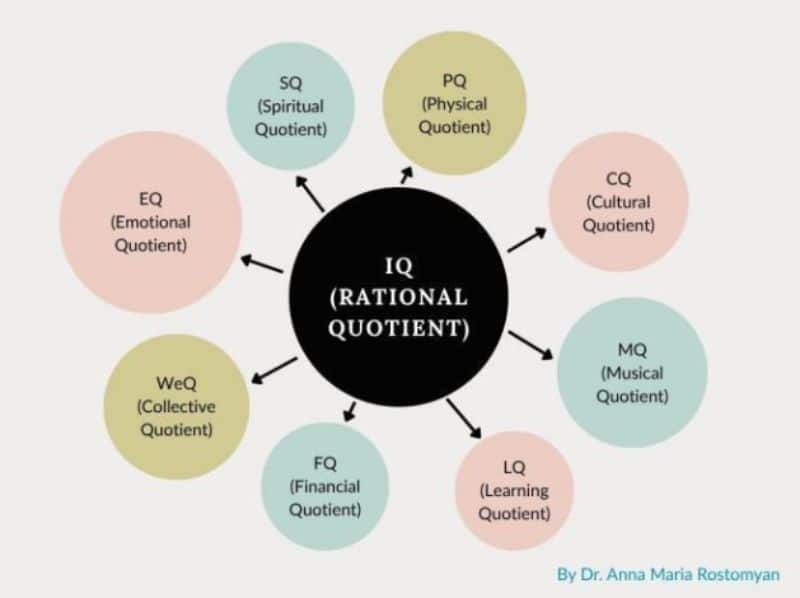
Chart: The Human Intelligences | Source: Rostomyan (2025)
Each of these intelligences adds immense value to how we think, feel, and interact. And they are deeply interrelated. Yet, let us focus on FQ, namely the female quotient, the female intelligence that adds huge value in mixed teams in companies and organizations. As we have given stated above, it is mostly believed that the right hemisphere of females responsible for creativity, emotions, and feeling is far more developed than that of their male counterparts, not always, but mostly, since we ladies are more often than not prone to taking decisions based on our inner states, emotions and feelings, intuition, and gut instinct. Taken this into account, if females are present in highly essential bodies in companies, organisations, and institutions, like Ursula van der Leyen, the President of the European Commission, or Christine Lagarde the President of the European Central Bank, we have creative thinkers that are able to add great value and lead their teams with heart, soul, and compassion. Moreover, it is also believed that women act decisively and confidently in challenging and stressful situations coming up with diverse creative solutions.
Furthermore, our research at Porsche Central and Eastern Europe (PCEE) and Porsche Center Yerevan has shown that women in companies are more inclined towards taking decisions based on their gut instinct and intuition as compared to their male counterparts.
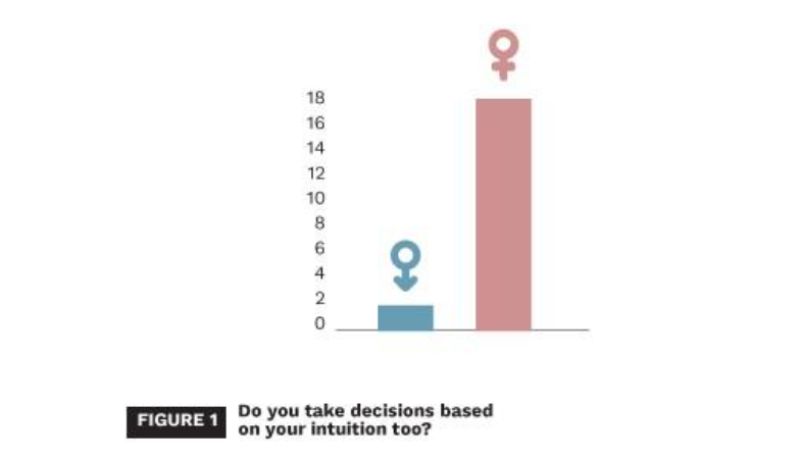
Figure 1: Intuition in Decision-making | Source: Rostomyan (2022)
As we can see in the infographic above, 18 women out of the 20 interviewed business professionals have responded that they base their decision on intuition, whereas only 2 men have responded that they place an importance on their intuition too. This comes to suggest that in case we include women in our teams, we can view issues from the angle of such seemingly minute, but highly important factors as intuition and gut instinct, since a business venture might seem beneficial from the first sight, but our emotions, intuition, and gut might tell us quite the opposite. This drives us to the ultimate conclusion that in case we have more women leaders, we can both boost our creativity and engage our intuition and gut in effective and successful decision-making.
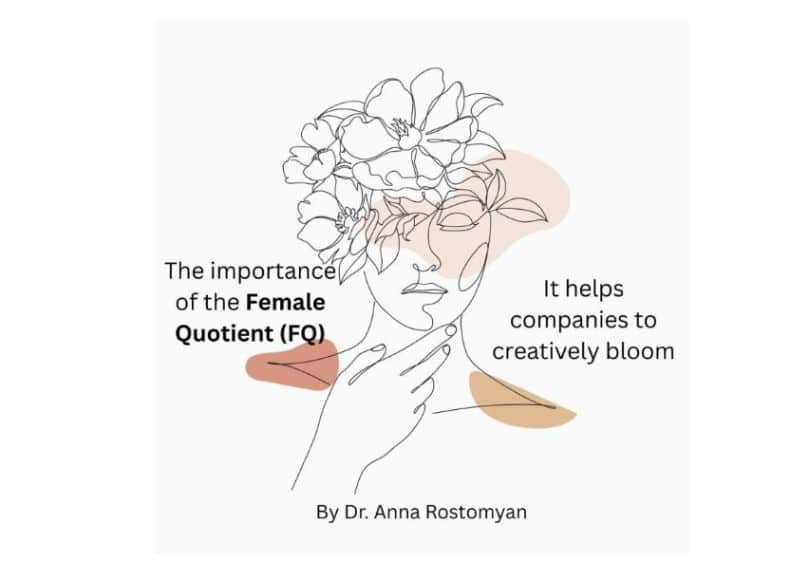
Infographic on the Female Quotient | Source: Rostomyan (2026)
In a nutshell, women and men function differently, there is no right or wrong way, yet in case we include them both in highly important business units, sometimes let women take leadership roles, we can eventually benefit from both of their intelligences.
Below are some tips on how to make the most out of our intelligences:
- Useful tips for C-suite level managers:
- Engage into various activities to enhance the functioning of both hemispheres.
- Keep each of the hemispheres active that will produce far more elaborate information for your activities by means of reviving the functioning of each of them.
- Read as much as possible to boost the regeneration between neurons.
- Listen to your gut instinct and intuition that also have relevant information to tell.
- Engage female workers and leaders into your teams to learn their perspectives.
- Analyse the functioning of the brain hemispheres of your employees based on their performance to be able to disseminate tasks accordingly.
- Be open to various viewpoints and keep them on the table to come up with the best possible decision.
- Also, base your decisions not only on pure facts, but also considering the interrelated emotions and feelings.
To conclude with, the newly coined term “female quotient” that comes to add value to all the other types of intelligences comes once again to prove that we women also add value to the table and in case men regard women not as threat or overly emotional, our teams will eventually greatly benefit from the “differently” functioning female brain. We are stronger together.
References
- Gardner, Howard (1983). Frames of Mind: The Theory of Multiple Intelligences. Nueva York: Basic Books.
- Goleman, Daniel (1995). Emotional Intelligence. New York, Toronto, London, Sydney, Auckland: Bantam Books.
- Rostomyan, Anna (2022). Efficient Decision-Making with EQ Skills in Business. The European Business Review. London, September 16.
- Rostomyan, Anna (2025). The Subtle Interplay of Human Intelligences. Cultural times, Australia, Issue 15, July.
Written by Ass. Prof. Dr. Anna Rostomyan. Have you read?
Media Training for CEOs: 4 Science-Backed Tips for High-Stakes Interviews.
Web3 Market Trends 2026: Animoca Brands’ Yat Siu on Regulation and RWAs.
How Education Drives Immigrant Success: Insights from Gohar Hambardzumyan.
How Computer Vision is Transforming Youth Sports: An Interview with Parthsarthi Rawat.
Why Institutional Knowledge is Your Biggest Competitive Advantage: Shavkat Saifiddinov.
Add CEOWORLD magazine as your preferred news source on Google News
Follow CEOWORLD magazine on: Google News, LinkedIn, Twitter, and Facebook.License and Republishing: The views in this article are the author’s own and do not represent CEOWORLD magazine. No part of this material may be copied, shared, or published without the magazine’s prior written permission. For media queries, please contact: info@ceoworld.biz. © CEOWORLD magazine LTD