



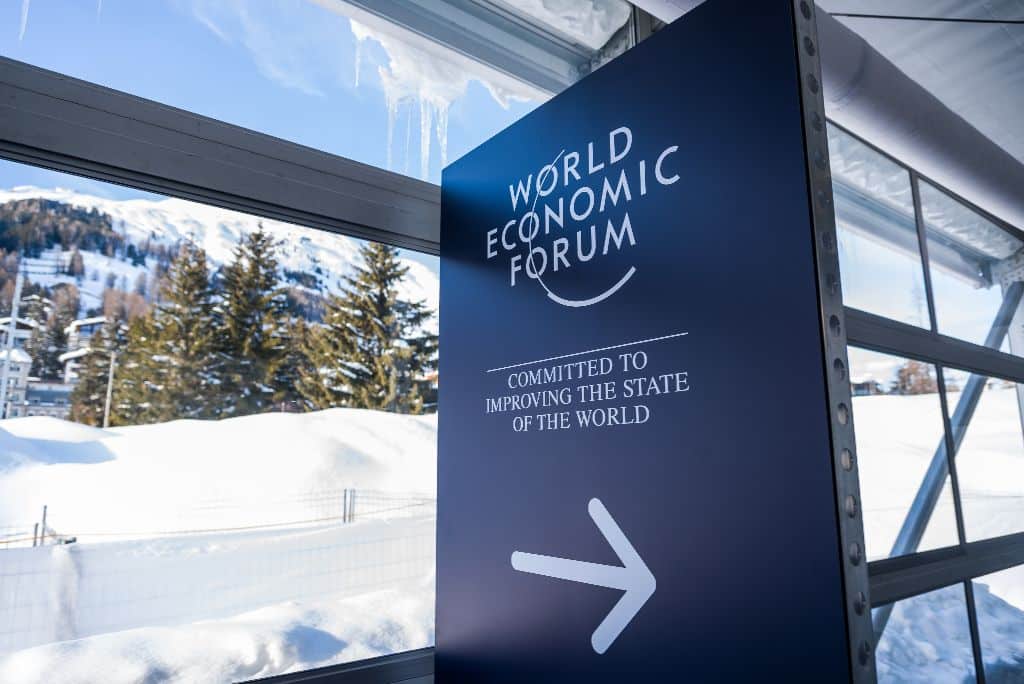
Davos has always been more than a conference for the global elite. It is where global anxiety crystallizes into agenda. It is where ambition either becomes architecture or evaporates into rhetoric. As the world enters 2026, one reality is unavoidable, because the era of ESG storytelling has quietly expired. In its place, a colder, harder reality has taken hold: Climate risk is no longer a side discussion in global economics. It is the operating environment.
The World Economic Forum convenes political leaders, CEOs, investors, and innovators precisely at this moment of collision. For the chief executive, the governing economic thought of the last thirty years labor arbitrage and outsourcing to low salary regions is dead. The race to the bottom for the cheapest dollar-per-hour is over. It has been replaced by a race for the cheapest – and cleanest electron.
Here is five defining answers for Davos 2026 and how clean energy arbitrage is becoming the new labor arbitrage.
First: Competitiveness is no longer defined as dollar per hour, but dollars per kilowatt hour.
Competitiveness is no longer measured in dollars per hour of labor, but in dollars per kilowatt-hour of energy.
Consider the factory floor. The multinational playbook of offshoring production to low-wage jurisdictions is obsolete. Here, multinationals previously outsourced manufacturing to low-wage jurisdictions. Today, robots and automated manufacturing are replacing blue-collar labor. These machines do not demand healthcare or holidays; they demand electricity. As robotics and industrial automation replaces manual labor, the “salary” of this new workforce quickly turns into electricity.
Now look at the traditional white white-collar labor, traditionally defined by headquarters and rooms full of employees, sometimes in impressive and expensive square meter locations. Here the same dynamic is aggressively disrupting knowledge work.
It is no news that AI models and agent now, and at a fraction of the cost, is able replace most cognitive tasks. This starting with the simple repetitive work and slowly, but surely, moving to more complex ones.
The step change here is that the overhead and OPEX is no longer defined in costly square meters nor highly experienced individuals. The cost of “AI intelligence” is measured in tokens. A Token is an AI unit of production, and every token is a product of not only the AI microchips that compute them on the models that run them – it is equally so, a product of the massive energy input needed to power the many energy hungry servers within the hyperscale data centers that train and run (inference) the future of work.
Profoundly, the fundamental unit of intellectual output has shifted from the “billable hour” to the “billable token”. Every token requires compute; every unit of compute requires power. Essentially, the AI play has become an energy play and the cost of drafting a contract, diagnosing a patient, or writing code is now a direct derivative of the price of power.
It is safe to say that any Owner, Chaiman, CEO & Executive, who wishes to stay competitive – or even dominate their field has to make tough decisions and trade-offs on in this brave new world, where AI and agents replaces traditional knowledge task and the completive factor is no longer measured in dollars per hour, but in dollars per megawatt-hour.
Second: Why CleanTech and low emission energy is essential
The speed and capital availability shows a clear trend. BloombergNEF’s (New Energy Finance) report on global energy transition shows that low-carbon energy investments hit parity to fossil fuels in 2022. The International Energy Agency’s (IEA) 2024 World Energy Investment report notes that global energy investment is now exceeding $3 trillion, with $2 trillion allocated to clean technologies infrastructure. Meaning while fossil investments staid stagnant, CleanTech investments nearly doubled from $1,1 trillon to over $2 trillion.
Further, 2026 marks a watershed moment for global trade. With the Carbon Border Adjustment Mechanism (CBAM) entering its definitive phase, carbon and emissions has effectively been weaponized as a tariff. Financial obligations turned into effect as of January 1st 2026 within the EU – essentially creating a tangible and financial incentive for CEOs in products containing; Iron & Steel, Cement, Aluminum, Fertilizers & pre-coursers, Hydrogen and electricity.
That means for corporations, decarbonization is no longer about values, or reputation. It is a margin-protection strategy. Importers of Iron, steel, aluminum, cement, fertilizers and hydrogen must now pay for the carbon intensity of their products at the border.
For nations, the stakes are even higher. Countries are no longer competing primarily on labor costs or subsidies. They are competing on the carbon intensity of their power grids. A “dirty” grid has become a structural trade barrier that no industrial policy can fully offset.
Energy, in this context, is no longer a background variable. It is the surrounding center of global competitiveness.
Third: How hungry Datacenters are crowding out traditional industries
This energy ramp-up and transition is hitting a “hockey stick” inflection point. If carbon pricing is the stick, artificial intelligence is the engine driving an unprecedented surge in power demand.
We are witnessing a “moon landing level” project for the 21st century. In the United States alone, data center consumption has risen from roughly 2% of the grid in 2020 to 5% today, with Department of Energy estimates projecting 9% by 2030 and credible sources above 70% in 2050.
This supply-demand mismatch is creating a three-tier energy hierarchy, already visible in unregulated markets like Texas (ERCOT), where the rule of thumb is that A: Residential buyers are priced out at around ~$30/MWh, while B: General Industry at around ~$50/MWh and C: The new Hyperscale Datacenters seem willing to pay up to ~$150/MWh to in order to secure capacity – at speed.
Artificial intelligence, digital infrastructure, and cleantech are now inseparable, yet policy frameworks remain siloed. Big Tech has started ignoring federal guidelines and securing its own capacity to power their hyperscale datacenters with renewables because they need to work around the constraints that real grid bottlenecks represents. Here “behind the meter” solutions – simply enables them to move faster than existing policy and infrastructure can respond.
The hyperscale datacenters needs the electricity now more than ever – and without a massive surge in supply, these high-margin “energy predators” will cannibalize the grid and without policy intervention, can potentially pose the risk of de-industrializing entire regions.
Fourth: How Supply Speed is the New Sovereign Risk
Perhaps most critical question for Davos 2026 is one of execution velocity. The transition is no longer a debate about “green premiums”; it is a race for structural resilience.
We are moving past the era where clean energy was viewed merely as an economic dividend. It must now be understood as a stability and continuity dividend.
In a geopolitical landscape fragmented by resource competition, distributed clean technology offers a path from dependency to abundance. By dissolving traditional resource chokepoints and localizing production, nations and corporations secure a “stability dividend” that fossil-fuel dependency can no longer provide.
The ultimate competitive advantage is no longer just labor or capital; it is the ability to guarantee a reliable, low-cost electron in a world of infinite demand. Those who cannot, will be outcompeted by the continents, countries and companies that can.
Traditional energy portfolios are insufficient. Incremental innovation and improvements will not close the gap. Hence Radical Innovation, that combines renewables, nuclear, geothermal, and fossil fuels with carbon capture is no longer ideological. It is imperative and mathematical, because your corporate strategy is only as good as your access to clean electrons.
Fifth: Why Davos still matters – Mechanisms for scale
Mechanisms for scale – this is why Davos still matters
We must move the conversation from “climate as sacrifice” to “climate as strategy,” and from isolated commitments to executable coalitions. Bridging deep-tech innovation, patient capital, and political authority. The main conference itself is only accessible to WEF Members and designated invites, normally a year long process – even for experienced CEO’s and with a higher rejection rate than Harvard University.
Here the Davos village includes secure hotels and platforms such as the Global CleanTech Forum, which serves as the catalytic mechanism to cross the valley between high level visitors, radical innovation and financial access. Because it is not enough to identify solutions; we must work together on engineering the “system-level de-risking” that allows trillions in deployed capital to flow at the speed of the crisis.
Finally, the central theme is Who Shapes the Future – and how?
The climate emergency does not wait for political cycles or market sentiment. CleanTech is not a future bet; it is a present necessity. As we move forward, some transitions will be disruptive, and some assets will inevitably become stranded.
Davos remains one of the few platforms where these truths can be discussed without illusion. The alignment of climate urgency, capital efficiency, and geopolitical realism is the only viable path forward.
In 2026, the real question is not whether the transition will happen. It is who will create it – and who will be affected by it.
Written by Radu Magdin (CEO, Smartlink Communications), Kumardev Chatterjee (CEO Blue Hat Founders, WEF Expert and Agenda Contributor, Co-Founder Global CleanTech Forum), and Thomas Tougaard (Co-Founder and Director, Global CleanTech Forum).|
Have you read?
Handling Employee Resignations: A Leader’s Guide to Graceful Notice Periods.
Scalable SOX Compliance: Building Audit-Ready Controls Without the Red Tape.
Next-Gen Retail: Nodari Andguladze on Laying the Groundwork for Coffee Innovation.
Women in AI: Top Entrepreneurs and Thought Leaders You Need to Follow.
From North Wales to Cumbria: The Impact of AI Growth Zones on the UK Economy?
Add CEOWORLD magazine as your preferred news source on Google News
Follow CEOWORLD magazine on: Google News, LinkedIn, Twitter, and Facebook.License and Republishing: The views in this article are the author’s own and do not represent CEOWORLD magazine. No part of this material may be copied, shared, or published without the magazine’s prior written permission. For media queries, please contact: info@ceoworld.biz. © CEOWORLD magazine LTD