




Are you familiar with the term Blue Monday? According to Google, it’s typically a Monday on which one feels gloomy or dispirited, especially because one has to return to work after the weekend. It’s also a term used to represent the 3rd Monday in January, dealing with gloomy weather and the bills associated with holiday shopping.
I have personally seen my mid-month payday dwindle to nothing after paying holiday bills. I’ve witnessed this gloom back in the day when I was paid twice a month.
Blue Monday has also been associated with high suicide rates in a lot of countries, which have increased every year over the last two decades.
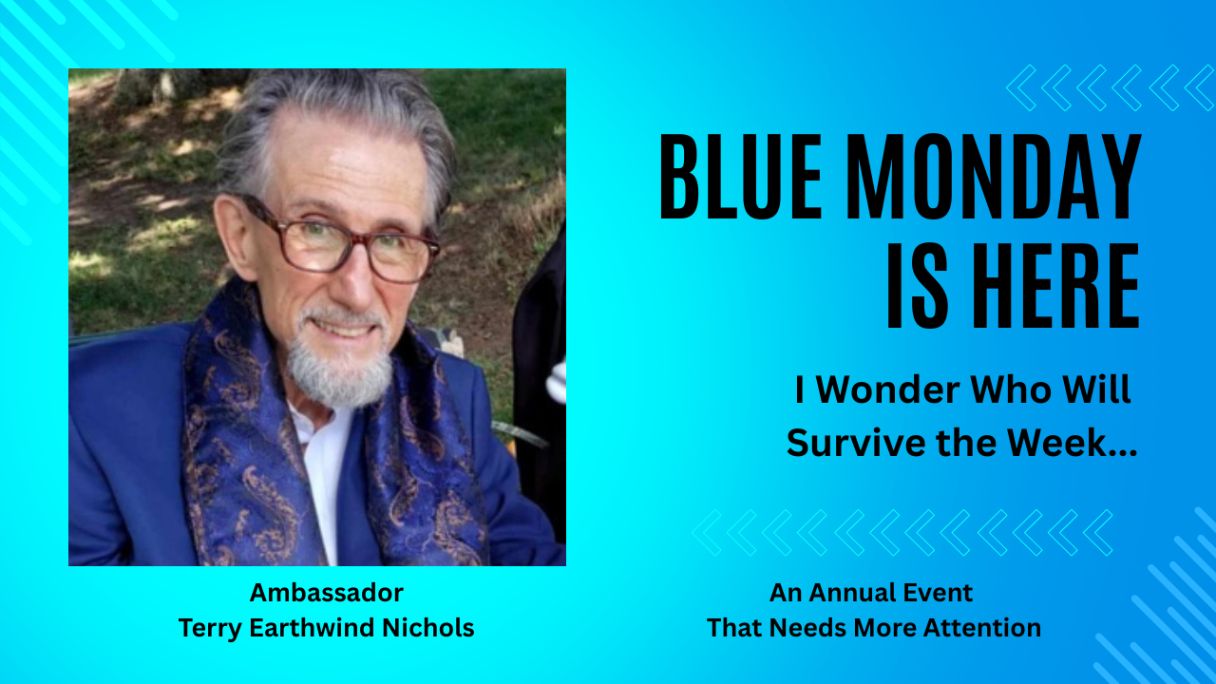
My company, Evolutionary Healer, along with my business partner and wife, Linda Vettrus-Nichols, is bringing this phenomenon in the human psyche to light. Over the years, we have created many social media campaigns to enlighten people that there are options available to get through the “Blue Monday Effect”.
We also use these campaigns as a springboard into a new year with new enthusiasm.
The other day, I spoke with someone who shared a simple and thoughtful tradition. Each year on Blue Monday, she places cheerful cards with personalized, handwritten notes on the desks of her direct reports. They are greeted with a small moment of encouragement when they arrive at work.
This kind of low-effort encouragement is especially effective on days when many people are already experiencing reduced mental capacity and neuro energy.
When neuro energy is low, even listening can feel taxing.
Processing spoken information requires significant mental effort, and on days like Blue Monday—when brains are already sluggish—too much talking can quickly become overwhelming. That’s why quiet, written gestures of encouragement can be so powerful: they offer support without demanding extra energy from the brain.
Remember Charlie Brown’s teacher from the cartoon series?
Pure noise when she spoke! And it was quite exhausting listening to her.
Letting people know they are not alone is an extraordinary step towards healing. Depression is about “disconnection”. And that “disconnection” isn’t just about feeling disconnected from others, it’s a disconnection within ourselves and a sense of being alone.
In 2009, I found myself standing on the edge of a 28-story building. Nothing was working in my life, and no one really knew.
I was perfectly calm and ready to step off the edge; I heard a voice saying, “Turn around, I have work for you”. When I turned around, no one was there. A few months later, I had created a unique profiling system that stops repetitive behaviors such as Suicide Ideation, Self-Sabotage, Procrastination, and even Post Traumatic Stress.
Now, as the father of Repetitive Behavior Cellular Regression® (RBCR), I am pleased and excited that my practitioners and I help people dealing with PTSD (Post Traumatic Stress Disorder/Response) and other repetitive behaviors, including and not limited to Suicide Ideation.
What is repetitive behavior?
Have you ever made a New Year’s resolution and failed to keep it the very next day? Did you make the same resolution the following year with the same results? If yes, this is considered repetitive behavior.
Making a conscious decision to do or not to do something and then failing to do so, two or more times, is my definition of repetitive behavior.
In my sixteen years of research, I have found that many repetitive behaviors, such as Post-Traumatic Stress Response (PTSR), Imposter Syndrome, Self-Sabotage, etc., come out of our thoughts almost non-stop, drawing us further into the abyss of depression.
Google defines Seasonal Affective Disorder (SAD) as a type of depression linked to seasonal changes, typically starting in fall/winter due to less sunlight, causing low energy, sadness, and social withdrawal.
This has also occurred in some of my clients who suffer severely in a certain month of the year. It has been interesting to see the connection after finding a highly emotional (amnesic) event that took place in early childhood during a certain time of year; many times resulting in PTSR.
I took a psychology class in high school and remember studying a little bit about Dr. Sigmund Freud. I had no motivation to take that class–now I’m grateful that I did.
Dr. Freud believed that what people suffered from in adult life stemmed from a traumatic event early in childhood. He was right, yet he couldn’t find a consistent method to find an amnesic, early childhood trauma using hypnosis and I did… WITHOUT the use of hypnosis… NLP, EMDR, EFT, drugs or psychotropics.
The unique thing I have noticed is that most of my clients suffered from an event that took place during a time of pre-language.
As Bessel van der Kolk, M.D. PhD. puts it: “Trauma comes back as a reaction, not a memory.”
So true, and that’s part of why it’s important to find an amnesic memory from early childhood, especially during the time of pre-language, without triggering the client.
Adverse Childhood Experiences or ACEs can be known or unknown.
Through our research we have found that there is a foundational ACE that has been walled off and is now in an amnesic-like state protecting an early childhood memory, typically pre-language.
Repetitive Behavior Cellular Regression® is a non-linear, sequencing model for getting to the core of repetitive behaviors. Through the CR Session we are able to by-pass conscious and
subconscious synchronization for memory recall. We are also able to keep our clients fully present and in a place of healthy detachment.
Rather than having a client tell us the story of a memory, we have them inventory a memory using their 5 senses, in a specific sequence. This is what makes RBCR so safe and why it doesn’t take a psych degree to become a CR Practitioner.
Many of our clients have told us they cannot recall memories from their childhood and that’s okay because we guide them to find what we call the Active Block and uncover that hidden memory with consistent positive results. This is done “without” tapping into emotions, which keeps the client from triggering.
Sometimes we get a client who is so afraid to go through the process because of what they “might” find, and they are pleasantly surprised that when they get there it’s no big deal. That’s always so interesting to witness.
I created RBCR while helping someone who was dealing with a lot of emotional trauma, and continually in and out of hospital psych wards. No therapies, medications, or techniques were working for her.
She is now married and living a normal life in her home with a great job. She loves connecting with others and is free of terrible nightmares. RBCR uses the 5 senses while observing body language and involuntary muscle movements.
It’s a question-and-answer process.
Psychologists work from the front of the brain back and hit one-way filters.
Modalities come in from the side and find blocks. We work from the back of the brain forward so filters don’t get in our way.
“RBCR, Repetitive Behavior Cellular Regression is literally a process that allows the client to open the back door of their mind.” ~Alexandra E.
To date of the 171 RBCR Sessions I have conducted, 160 were completed in 1 session, 5 clients never finished the process, and 6 required 1 to 3 continuation sessions. We are now on 6 continents and in 17 countries, including 27 US States and 3 Canadian provinces. The CR Process is now available in 4 languages.
The CR Process is a behavioral health training model that helps a person understand and control their own stressors. White Papers https://www.evolutionaryhealer.com/white-paper-for-the-cr-process
“Knowledge is of two kinds. We know a subject ourselves, or we know where we can find information upon it.” ~Samuel Johnson
Written by Terry Earthwind Nichols. Have you read?
Why Leadership Communication Fails: The Hidden “Intent Problem.”
Ways Arbor Users Save on Electricity (Without The Utility Switch).
Institutional-Grade Governance: Managing Operational Risk in Alternative Investments.
Scaling Content Delivery and Web Security: Insights from Vinod Thottempudi.
Why Long-Term Client Relationships Outperform Digital Marketing Trends.
Add CEOWORLD magazine as your preferred news source on Google News
Follow CEOWORLD magazine on: Google News, LinkedIn, Twitter, and Facebook.License and Republishing: The views in this article are the author’s own and do not represent CEOWORLD magazine. No part of this material may be copied, shared, or published without the magazine’s prior written permission. For media queries, please contact: info@ceoworld.biz. © CEOWORLD magazine LTD