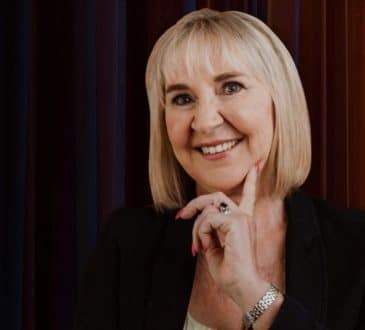



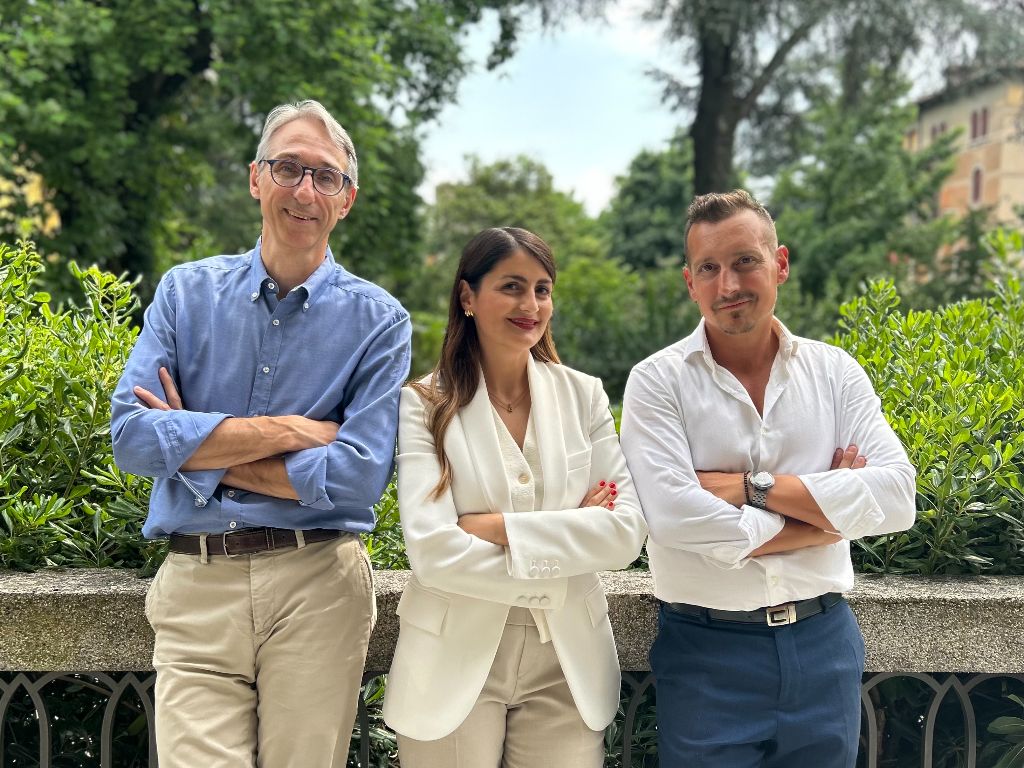
I find it truly fascinating to use exponential technologies to build a virtuous and social network where everyone benefits, and where even micro-transactions are feasible and manageable at scale. This way, it’s possible to help those at the margin of society even with the little they need (for example, a small purchase of groceries), ensuring transparency and security for donors, participants, helpers, and controllers. Here is the case of WeSherpa. We interviewed Maria Rosaria Sanna, co-founder of the Lugano-based startup, who reconciles technology and community in everyday life. They have just started, but the potential is evident. Here’s our conversation.
Tell us a bit about yourself and your background.
My professional journey began in marketing, but in recent years I’ve had the opportunity to delve into ESG topics, which led me in 2022 to pursue some training in Sustainability and Impact at the Polimi Graduate School of Management. My connection with Ticino is relatively recent but very meaningful: it was here that, thanks to Pierfranco Sofia, with whom I shared the master’s program and who involved me in the WeSherpa project, I was introduced to a context strongly oriented towards local social innovation. His entrepreneurial drive, combined with the deep knowledge of the territory and institutional dimension brought by Paolo Bortolin, were crucial ingredients in building our team.
WeSherpa is a project that brings together different backgrounds — economic, social, and technological — around a shared vision: to demonstrate that redistributing purchasing power is more profitable than concentrating wealth. In essence, if we have an effective tool for financial inclusion, like our network, we can guarantee impacts that traditional donation models do not achieve.
So, what is WeSherpa? What does it do and what stage is the project at? Tell us more.
WeSherpa is a fintech startup with a social vocation, born with the goal of transforming donations into simple, everyday gestures close to the community. We were inspired by the concept of “suspended economy”: consumers can deposit credit at essential goods stores so that someone in need can purchase those items at a reduced price, with dignity and according to their needs. Everything happens digitally, tracked and transparent through our app. Donations are redeemed at 100% and can only be used by beneficiaries certified by local social organizations, generating a concrete impact instantly.
The model is economically supported by partner stores who pay a percentage fee on the donations they receive, which for them is effectively an additional revenue. With that fee, we maintain the platform. In this way, generosity directly produces real socioeconomic value and translates immediately into tangible benefits for both recipients and stores, contributing to the well-being of the community, while the donor also gains the advantage of reducing their taxable income.
It’s a network because it’s possible to donate remotely, for example, for companies. A local business can adopt WeSherpa as a solution to support its community by donating. Donations are channelled to partner stores. The business receives an instant certificate, which will eventually become an NFT, useful for non-financial reporting and gains visibility on the app among citizen donors. In short, it’s a transparent gesture to say, “I am here and truly supporting my community, I want to guarantee fair access to essential goods in local stores.”
Today, we are in a very dynamic phase: we have launched our market test in Ticino, with 11 active stores and aim to reach 20 in the coming weeks, expanding territorial coverage and offered services. The initial signals are decidedly encouraging; our data show that for a purchase of 10 CHF, a consumer adds at least 5 CHF. This is also interesting for stores: we’re talking about a 50% increase in sales. This confirms that we’re on the right track.
Do you use exponential technologies like AI or Blockchain? How will they change our world?
WeSherpa was born as a “blockchain for good” project as part of Pierfranco’s thesis for his Master in Sustainability and Impact. As you know, measuring social impacts is still a complex topic (it’s much more complex to measure long-term social impacts than environmental ones), and it has interesting market potential in the impact finance sector.
Today, the project has become a true “profit with purpose” model. We are engineering the use of blockchain and will begin its prototyping in the coming months, in parallel with the web 2 evolution of the service (app + payment network). For us, technology is not an end, but an enabling tool—it’s used to make social impact measurable, which is a fundamental prerequisite for building trust and creating a truly transparent model.
The idea of measuring impact in web 3.0 is still at the heart of our blockchain use, and donation certificates—especially for businesses—will be issued as Social Credit: an NFT product that allows companies to demonstrate instant and local social impact, which can be included in their sustainability report with a click. Our goal is to launch this technical infrastructure development by 2026, which will be feasible once we’ve raised capital and proven the business idea’s validity in the market.
The role of exponential technologies in marketing is transformative. As a marketing professional, I grew up thinking about increasingly sophisticated and precise targets, but I also spent many hours counting how many out-of-target consumers I had reached, because the needs and factors driving purchasing are extremely fluid and mutable. Algorithms will be faster than us at skipping certain patterns to focus directly on conversion goals and optimizing investments to maximize the result, identifying people most likely to respond to certain stimuli, regardless of sociodemographic characteristics. The good news is that we, as humans, will always be called to listen and have a deep understanding of people, generating value propositions that truly make sense for someone.
Add CEOWORLD magazine as your preferred news source on Google News
Follow CEOWORLD magazine on: Google News, LinkedIn, Twitter, and Facebook.License and Republishing: The views in this article are the author’s own and do not represent CEOWORLD magazine. No part of this material may be copied, shared, or published without the magazine’s prior written permission. For media queries, please contact: info@ceoworld.biz. © CEOWORLD magazine LTD