




A Simple Way to Make Leadership Development More Effective
For the past 25 years, leadership development has increasingly focused on soft skills. Over the same period, project and change initiative failure rates have barely moved. That may explain why 75% of organisations say their leadership development is not effective.
Continuing to double down on vulnerability, authenticity, and “leading with presence” while results remain flat doesn’t just defy the data — it borders on madness. So instead of asking how do we make leaders nicer, let’s start with a more useful question:
- Why isn’t leadership development experienced as effective?
- And why do so many change initiatives still fail?
The gap no one wants to talk about
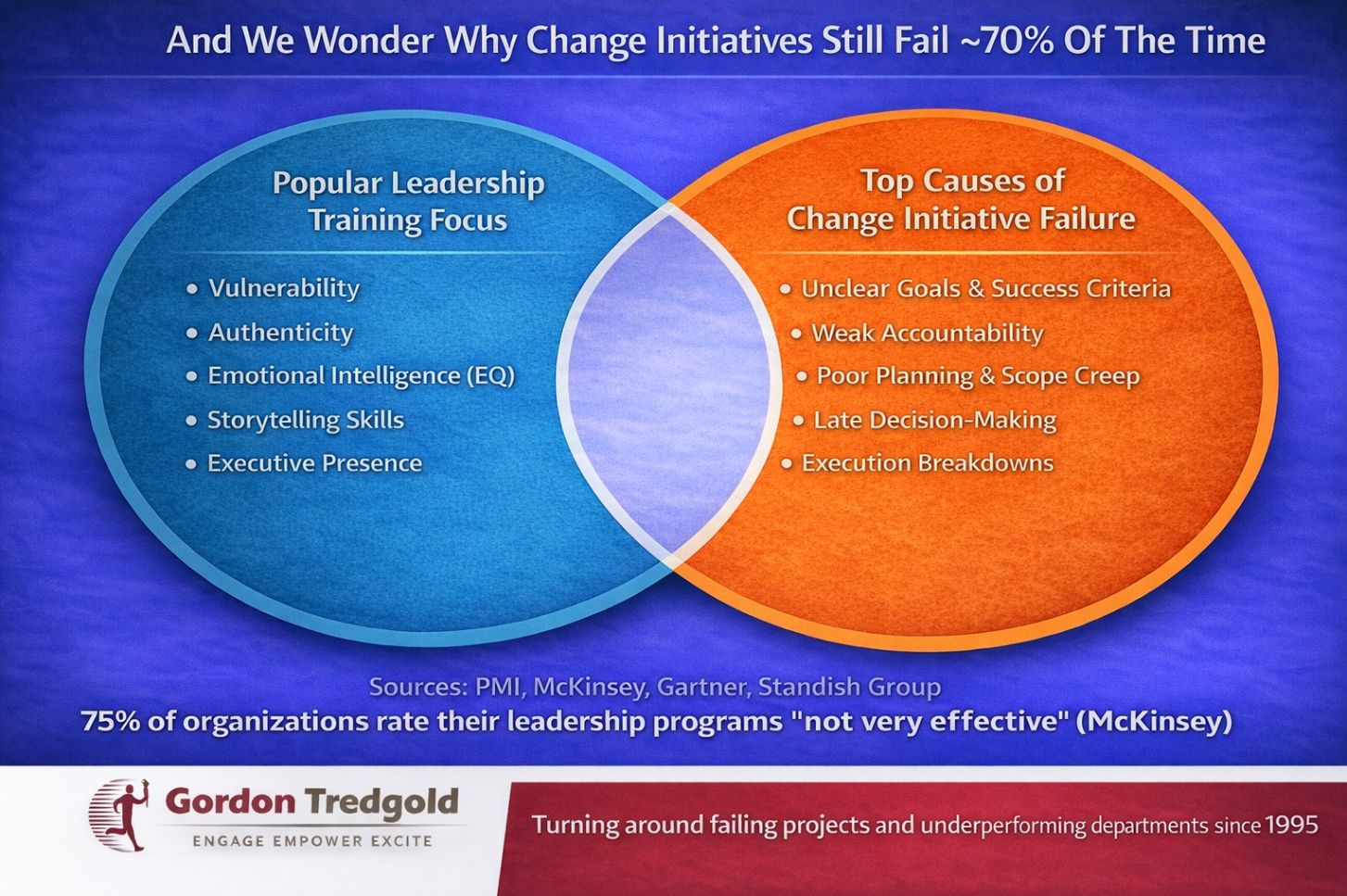
When you look at the most popular leadership training topics and compare them with the main reasons change initiatives fail, something uncomfortable appears.
They barely overlap.
Leadership training focuses on:
- Vulnerability
- Authenticity
- Emotional intelligence
- Storytelling
- Executive presence
Change initiatives fail because of:
- Unclear goals
- Weak accountability
- Poor planning and scope control
- Late or avoided decision-making
- Execution breakdowns
These are not the same things.
And yet we keep acting as if training one will somehow fix the other.
Why this keeps happening
Soft skills are not the problem.
They are necessary — just not sufficient.
They are like oil in a car engine.
Without them, performance isn’t sustainable.
But oil is not the driving force.
If all you focus on is oil, the car will technically run — but it won’t perform, it won’t accelerate, and it won’t win races.
Leadership development has made the same mistake.
The uncomfortable organisational reality
Nice leaders who don’t deliver get fired.
Toxic leaders who deliver — often in spite of the damage they cause — get tolerated, retained, and sometimes promoted.
I’ve seen this throughout my career.
Yes, organisations may send those leaders on emotional intelligence or empathy training.
But their behaviour is tolerated because results matter more than intentions.
That’s not how it should be.
It’s how organisations actually behave.
Why behaviour-first leadership development fails
Training soft skills is fundamentally about behavioural change.
Behavioural change is:
- Slow
- Identity-threatening
- Context-dependent
- Easily overridden under pressure
Even when it works, it doesn’t help people-centric leaders deliver better results.
And here’s the deeper problem:
Training behaviour is harder than teaching skills.
Millions of divorced people would tell you how hard it is to change toxic behaviour.
Yet somehow we believe a two-day leadership course will succeed where years of counselling failed.
At some point, this stops being optimistic and starts being irrational.
The leadership development trade-off we keep missing
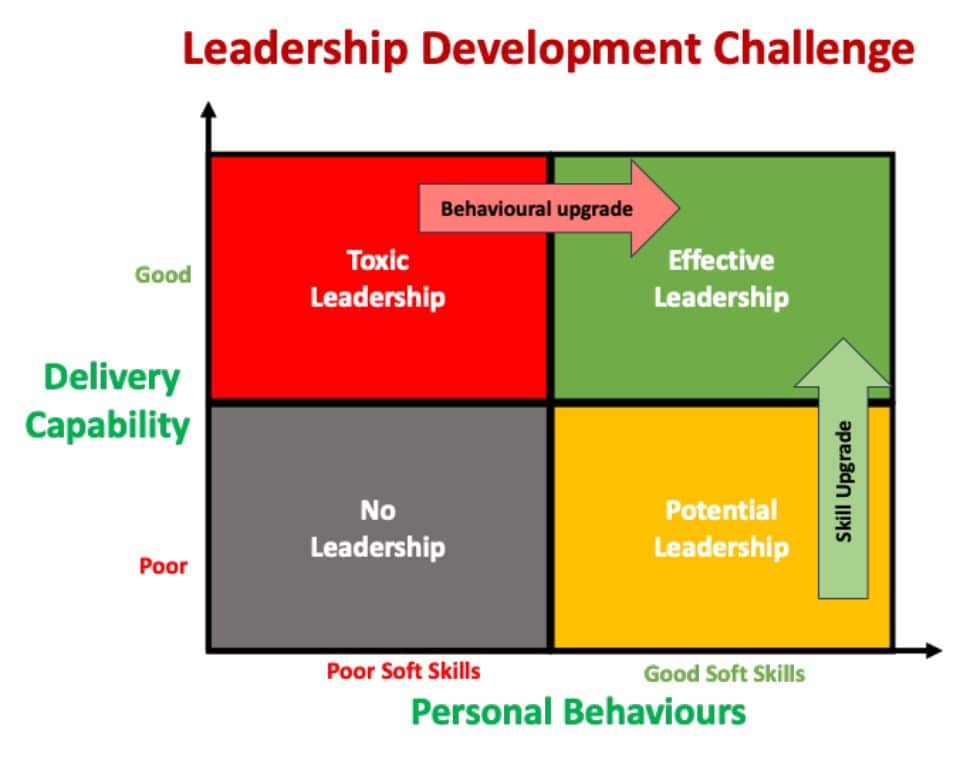
There are two very different paths to effective leadership:
- Trying to rehabilitate toxic leaders through behavioural change
- Taking people-centric leaders and upgrading their delivery capability
Only one of these paths consistently works.
The highest-ROI leadership development strategy
The biggest missed opportunity in leadership development sits in plain sight.
It’s not the toxic high performers.
It’s not the people with poor behaviours and poor results.
It’s the people-centric leaders with potential — those who care about people but haven’t yet been taught how to deliver consistently.
Teaching them delivery skills is:
- Faster
- More reliable
- Less risky
- More scalable
This is about skills upgrade, not personality change.
And it works.
Across multiple organisations, change success rates moved from around 30% (industry norm) to 70%+ — not by making leaders “nicer”, but by making good leaders effective.
Why leadership development feels ineffective
McKinsey reports that 75% of organisations say their leadership development is not effective.
That shouldn’t surprise us.
If leadership development doesn’t help organisations deliver results, it won’t be experienced as effective — no matter how well-intentioned it is.
Sustainable leadership requires both:
- People-centric leadership
- Results-driven capability
But the sequence matters.
A simple way to make leadership development more effective
Stop trying to fix toxic leaders.
Find good people.
Teach them to deliver.
Layer soft skills as an amplifier — not as a substitute.
That’s how leadership development starts to move the needle.
Written by Gordon Tredgold.
Add CEOWORLD magazine as your preferred news source on Google News
Follow CEOWORLD magazine on: Google News, LinkedIn, Twitter, and Facebook.License and Republishing: The views in this article are the author’s own and do not represent CEOWORLD magazine. No part of this material may be copied, shared, or published without the magazine’s prior written permission. For media queries, please contact: info@ceoworld.biz. © CEOWORLD magazine LTD