



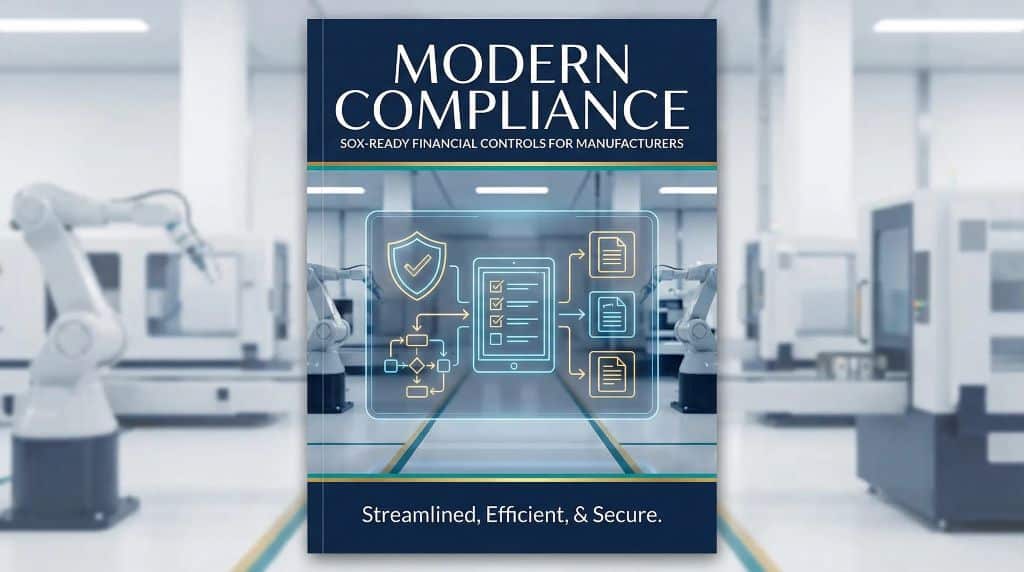
Small manufacturers preparing for an IPO, merger, or private equity investment often face a sobering reality: investors want to see strong financial controls. The Sarbanes-Oxley Act (SOX) sets the gold standard for these controls. But many small businesses assume SOX compliance means drowning in paperwork and hiring expensive consultants.
It doesn’t have to.
You can build SOX-ready internal controls that satisfy auditors and investors without creating a bureaucratic nightmare. The key is starting with what matters and building from there.
The payoff is real. Research published by the Harvard Law School Forum on Corporate Governance found that private firms with stronger SOX compliance received higher valuations when acquired by public companies. Being SOX-ready before you need to be can translate directly into better deal terms.
What Does SOX-Ready Actually Mean?
SOX Section 404 requires public companies to document and test their internal controls over financial reporting. Being SOX-ready means your controls could withstand that scrutiny, even if you’re not yet required to comply.
For manufacturers, this translates to five practical requirements. Each control must be designed to address a specific risk to your financial statements. Controls must operate effectively working consistently, not just when someone remembers. Documentation matters, where someone should be able to understand what happens, who does it, and where the evidence lives. You need testing to check periodically that controls still work. And when something breaks, you need remediation, meaning working on fixing the problem and documenting the fix.
Most small manufacturers already do versions of these things. The problem is they’re informal and undocumented.
The biggest mistake small manufacturers make is trying to control everything at once. For most manufacturers, three areas create the majority of financial risk:
- Revenue recognition. When do you book a sale? Who approves credits and adjustments?
- Inventory valuation. How do you track inventory? Who adjusts counts? How do you handle obsolescence?
- Cash disbursements. Who can authorize payments? How do you prevent duplicate payments?
Start by documenting your controls in these three areas. You’ll cover 80% of what auditors care about.
The Four Control Types You Need
SOX frameworks like COSO organize controls into categories. Here’s what that looks like in practice.
Entity-level controls are company-wide policies. These include a written code of ethics, regular risk discussions at leadership meetings, and clear reporting lines for financial concerns. Most manufacturers have these informally. Write them down and review them annually.
Process-level controls happen during daily operations. The plant manager reviews production variances weekly. The controller reconciles bank accounts monthly. The CFO approves all journal entries over $10,000. Document who does what and how often.
IT general controls protect your financial systems. Only three people can change pricing in your ERP. Someone reviews the user access list quarterly. System changes go through a test environment first. Even basic controls here matter.
Automated controls are built into your systems. Your ERP won’t let someone approve their own purchase order. Manual controls require human action, such as a supervisor reviewing timecards before payroll runs. Automated controls are more reliable. When possible, build controls into your systems rather than relying on people remembering to check.
Documentation That Works
Good control documentation answers four questions: what risk does this control address, what specifically happens, who is responsible, and where’s the evidence. A one-page control description can cover all four. You don’t need elaborate flowcharts unless they actually help people understand the process.
Keep evidence simple too. If your CFO reviews bank reconciliations, save the reconciliation with their initials and date. If your system logs who approved a transaction, that log is your evidence. Testing means checking that controls actually happened. Pick a sample of transactions and verify the control operated. If the control is manager approves all invoices over $5,000, pull five invoices over $5,000 from last month and confirm they were approved. When testing finds a problem, document what happened and how you fixed it. Auditors expect some issues. They don’t expect you to ignore them.
Practical Steps to Start
If you’re starting from scratch, here’s a 90-day approach.
In month one, list your top 10 financial risks. For each risk, write down what control currently exists, even if informal. Identify gaps where no control exists.
In month two, document your most important controls using the four-question format. Focus on revenue, inventory, and cash. Assign owners to each control.
In month three, test five controls. Fix what’s broken. Schedule quarterly testing going forward.
This won’t make you fully SOX-compliant overnight. But it will give you a foundation that investors and auditors respect, and that makes your business stronger regardless of any future IPO or sale.
Conclusion
SOX-ready controls ensure your financial numbers are trustworthy. For small manufacturers, this reliability builds credibility that attracts lenders, investors, and customers. Best of all, you do not need a full compliance team. You only need to think clearly about potential risks, keep simple records of your safeguards, and regularly verify they work.
Have you read?
Media Training for CEOs: 4 Science-Backed Tips for High-Stakes Interviews.
Web3 Market Trends 2026: Animoca Brands’ Yat Siu on Regulation and RWAs.
How Education Drives Immigrant Success: Insights from Gohar Hambardzumyan.
How Computer Vision is Transforming Youth Sports: An Interview with Parthsarthi Rawat.
Why Institutional Knowledge is Your Biggest Competitive Advantage: Shavkat Saifiddinov.
Add CEOWORLD magazine as your preferred news source on Google News
Follow CEOWORLD magazine on: Google News, LinkedIn, Twitter, and Facebook.License and Republishing: The views in this article are the author’s own and do not represent CEOWORLD magazine. No part of this material may be copied, shared, or published without the magazine’s prior written permission. For media queries, please contact: info@ceoworld.biz. © CEOWORLD magazine LTD