


Six Outcomes Leaders Can Realize by Strengthening Peer Relationships in 2026


As organizations move into 2026, leaders are navigating a complex reality. Expectations for performance continue to rise, yet engagement remains stubbornly low across many industries. According to Gallup, only about 23 percent of employees globally report being engaged at work. At the same time, stress and anxiety remain common, with a majority of employees saying they experience stress on a daily basis.
While anxiety and burnout deserve attention, they are symptoms rather than root causes. The deeper challenge facing organizations is a lack of connection, shared ownership, and collective momentum. People are often working hard, but not always together. And when effort is fragmented, productivity suffers, learning slows, and leadership becomes more burdensome than necessary.
What many organizations overlook is that performance is not driven solely by strategy, incentives, or individual capability. It is shaped just as powerfully by the quality of peer relationships inside teams. Peers influence how people learn, how they show up as leaders, how accountable they feel, and how much energy they bring to their work. When those relationships are intentional and healthy, engagement rises, and productivity follows.
Leaders who invest in strengthening peer relationships tend to realize six outcomes that matter deeply in today’s workplace: Learning, Leadership, Leverage, Life, Longevity, and Legacy.
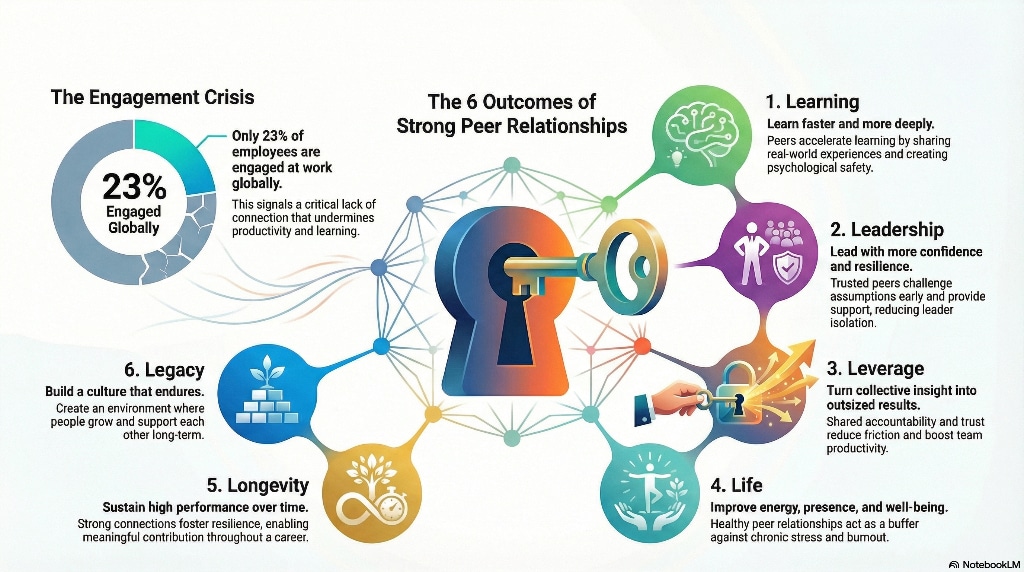
Learning: We Learn Faster and More Deeply Through Peers
Formal training remains important, but it is no longer sufficient on its own. Most workplace learning happens in the flow of work — through dialogue, problem-solving, experimentation, and reflection with others who understand the context.
Peers accelerate learning because they operate close to reality. They test ideas against real constraints, share experience rather than theory, and surface blind spots quickly. In strong peer environments, people ask better questions, admit uncertainty sooner, and apply insights faster.
Importantly, formal peer learning is most effective when it is intentionally designed as a peer-to-peer activity, not a top-down transfer of information. When learning is structured among equals, rather than experts dispensing insight, engagement increases. Participants take greater ownership of the learning process, challenge one another constructively, and focus more on application than abstraction.
Psychological safety plays a key role. In peer settings where people feel safe admitting what they do not know, learning accelerates. Curiosity replaces defensiveness. Over time, this fosters teams that learn continuously rather than episodically.
Leadership: We Lead Better When We Are Challenged and Supported
Leadership is often treated as a solo responsibility, yet that framing contributes directly to isolation and fatigue. Many leaders make decisions on their own, testing their thinking only after suffering the consequences.
Strong peer relationships fundamentally change the leadership experience. Leaders with trusted peers are challenged earlier and more honestly. Their assumptions are tested before decisions are finalized. This leads to better judgment, greater self-awareness, and fewer costly missteps.
Equally important, peers provide support without removing accountability. Leaders feel less alone, which reduces anxiety, but they are also held to higher standards by those they respect. The result is leadership that is steadier, more confident, and more resilient, qualities that directly influence team engagement and performance.
Leverage: We Turn Collective Insight Into Outsized Results
When peer relationships are strong, productivity becomes a shared endeavor rather than an individual pursuit. Teams with high trust and mutual accountability consistently outperform less connected teams, particularly when work is complex or interdependent.
Peer leverage reduces friction. Expectations are clearer because they are reinforced socially. Feedback moves faster because it is normalized. Accountability feels shared rather than imposed, which increases follow-through without increasing fear.
This is where engagement and productivity intersect most clearly. People work harder and smarter when they know their effort matters to peers they respect. They don’t want to let them down. Momentum builds not through pressure from above, but because peers collectively raise expectations.
Life: We Bring More Energy and Presence to Our Work
Stress remains a reality of modern work, but its impact is shaped by relationships. Chronic stress is far more damaging when people feel isolated than when they feel supported.
Healthy peer relationships act as a buffer. They reduce unnecessary anxiety by creating shared understanding and perspective. Challenges feel more manageable when they are discussed openly rather than carried privately.
As a result, people show up with more energy and presence. Engagement rises because work feels more human and less transactional. Productivity improves because energy is spent creating value rather than managing isolation.
Longevity: We Sustain Performance Over Time
High performance is meaningless if it cannot be sustained. Longevity reframes success not as a sprint of intensity, but as the ability to contribute meaningfully over time without sacrificing health or perspective.
Research consistently shows that strong relationships protect against burnout and disengagement. Leaders who operate within healthy peer environments experience greater resilience, better emotional regulation, and longer productive careers.
Longevity creates the runway for everything else. It allows learning to compound, leadership to mature, and contribution to deepen over time.
Legacy: We Leave Something That Endures
One of the longest-running studies on adult development has shown that strong relationships are the most consistent predictor of long, healthy lives. At work, legacy is shaped not only by results, but by the cultures leaders leave behind.
Leaders who invest in peer relationships create environments where people grow, perform, and support one another long after any single leader moves on. That legacy endures, both organizationally and personally.
Summary: Leadership Expectations for 2026
As leadership expectations continue to evolve in 2026, effectiveness is measured by more than outcomes alone. Leaders are judged by the conditions they create that enable engagement, learning, accountability, and sustained performance.
Those who strengthen peer relationships are not avoiding pressure; they are channeling it productively. They build organizations that learn faster, lead more generously, and perform more consistently over time. In a world where engagement is fragile and complexity is constant, peer relationships are no longer a “soft” factor. They are a strategic advantage.
Add CEOWORLD magazine as your preferred news source on Google News
Follow CEOWORLD magazine on: Google News, LinkedIn, Twitter, and Facebook.License and Republishing: The views in this article are the author’s own and do not represent CEOWORLD magazine. No part of this material may be copied, shared, or published without the magazine’s prior written permission. For media queries, please contact: info@ceoworld.biz. © CEOWORLD magazine LTD