


The Productivity Bridge: Why Results Permit Groups & Teams to Expect More


For years, Harvard Business School Professor and best-selling author Amy Edmondson’s research on psychological safety has given leaders a powerful lens for understanding team performance. Edmondson’s well-known 2×2 model, which shows psychological safety and accountability not as opposing forces, but as necessary partners, clearly illustrates where high performance lives: the Learning Zone. She characterizes it as the optimal environment where teams have both high psychological safety and high accountability.

The model is both elegant and accurate. Yet in my work with CEO forums and organizational teams, I’m often asked, “How does this happen?” “How does having psychological safety alone help team members believe they can expect more of themselves?”
To answer these questions about groups (and possibly teams), I examined Peernovation’s Five-Factor model for high-performing peer groups, a reinforcing loop that places productivity between psychological safety and accountability. This model suggests that for groups, achieving psychological safety is not an end goal or something to be attained for its own sake, but a vital step in fostering greater group productivity and accountability.

Edmondson’s model shows us where high performance happens. What it doesn’t explicitly explain (at least for me) is how teams gain the confidence to raise expectations without fear. What provides the evidence and gives group and team members the permission to shed their self-limiting beliefs and ask more of themselves? The Five Factors would suggest that it’s productivity. Let’s see where it takes us.
Psychological Safety Is a Starting Point, Not a Destination
Edmondson has been clear, and often misunderstood, about what psychological safety is and isn’t. It’s not about being nice. It’s not about lowering standards. It’s about creating an environment where people feel safe to take interpersonal risks in the service of learning and high performance.
When psychological safety is present, team members are more likely to:
- Feel accepted for who they are
- Speak up with concerns or dissenting views
- Admit mistakes and ask questions
- Seek out help and be open to giving and receiving feedback
- Experiment, learn, and grow
These behaviors are essential to driving higher quality engagements and greater productivity. I see this happening in CEO Forums regularly. The resulting improvements help members experience the tangible benefits of creating and living in a psychologically safe space, while giving them the confidence that they may be capable of even more than they ever realized. Productivity gains provide group members with evidence that psychological safety works, not as a philosophy, but as a lived experience.
Productivity as Proof That Psychological Safety is a Game-Changer
In high-performing peer forums, something fascinating happens. As trust and candor increase, members don’t just feel better; they perform better. Conversations run deeper, and they talk less about symptoms and more about root causes. They prepare more thoroughly, participate more actively, and ask questions with greater veracity.
That progress, as incremental as it can be at times, matters more than members often realize. When forum members see how honest dialogue improves outcomes, there is not only a shift in the group, but a new understanding of how psychological safety can drive higher performance in their organizations.
Shedding Self-Limiting Beliefs
Every group, and, I would suggest, team carries unspoken assumptions about what’s possible:
- “That’s just the way we work.”
- “We’re not great at holding each other accountable.”
- “If we push harder, people will shut down.”
These beliefs are rarely challenged directly. They fade in an environment where psychological safety is high and when contradicted by experience.
When groups and teams see tangible improvement, they begin to shed their self-limiting beliefs. Confidence grows organically, not through exhortation but through evidence. And with confidence comes permission. This serves as the bridge to the Learning Zone.
Raising Expectations Without Fear
CEO Forums that have experienced productivity gains begin to raise expectations of one another, not because the Group Chair or Forum Leader demands it, but because the members now believe it’s both fair and achievable.
The internal conversation changes:
- From “Who am I to challenge you?”
- To “We owe it to each other to bring our best.”
Accountability stops feeling imposed and starts feeling earned. Peer-to-peer challenge becomes an act of respect. Stretch no longer triggers anxiety because it’s grounded in proof.
The Productivity Bridge to the Learning Zone
This dynamic can be visualized as a bridge: The Productivity Bridge to the Learning Zone.
Psychological safety creates the conditions for better collaboration.
Better collaboration leads to better work.
Better work builds confidence.
Confidence allows teams to raise expectations without fear.
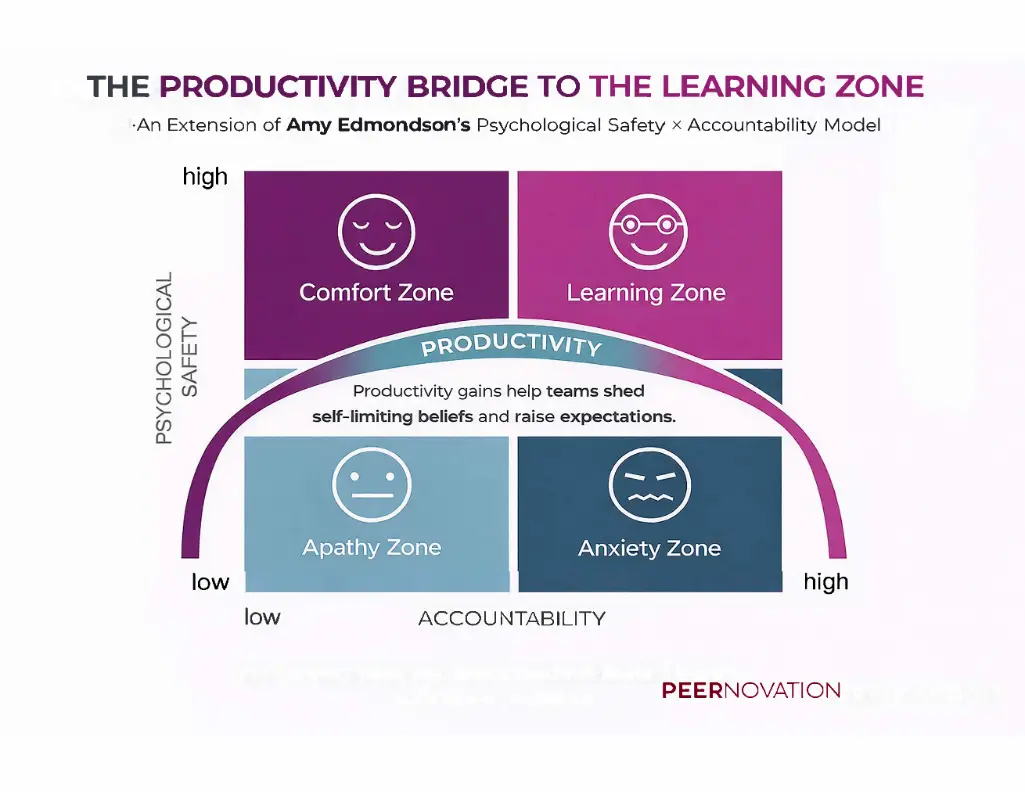
Or more simply:
Productivity gains help teams shed self-limiting beliefs and raise expectations – performance, behavior, contribution, and of one another.
Productivity doesn’t replace psychological safety or accountability. It connects them. It is the reinforcing mechanism that allows teams to move from intention to high performance.
Why This Matters for Leaders
For CEOs and senior leaders, the implication is clear:
- Don’t double down on accountability before teams have evidence they can succeed.
- Don’t treat psychological safety as an end state.
- Pay attention to early productivity gains and how they impact team confidence.
When leaders recognize productivity as proof rather than pressure, they stop asking, “How do I hold people more accountable?” and start asking, “What conditions will allow this team to believe they’re capable of more?”
That shift makes all the difference.
Standing on Strong Shoulders
Amy Edmondson’s work has given leaders an indispensable framework for understanding team dynamics. The Productivity Bridge doesn’t compete with that model; it humbly offers additional clarity by explaining how groups and teams can enter the Learning Zone and understand what it takes to stay there.
That said, I offer this point of view as the start of a conversation; so let’s keep it going in CEO Forums, inside the walls of today’s organizations, and in the halls of our top academic institutions, where researchers can either prove, disprove, or build on what’s been suggested here.
Add CEOWORLD magazine as your preferred news source on Google News
Follow CEOWORLD magazine on: Google News, LinkedIn, Twitter, and Facebook.License and Republishing: The views in this article are the author’s own and do not represent CEOWORLD magazine. No part of this material may be copied, shared, or published without the magazine’s prior written permission. For media queries, please contact: info@ceoworld.biz. © CEOWORLD magazine LTD