



More than a decade ago, when I first began writing books about the power of peers, I started with a simple truth people intuitively understand because they’ve lived it their entire lives: who we surround ourselves with matters. Our language proves the point: birds of a feather flock together, we’re known by the company we keep, a rising tide lifts all boats. Peers shape our behavior long before any leadership model or management theory enters the picture.
That premise only strengthened as my work evolved. For my second book, I interviewed 50 high achievers from every imaginable background and asked each of them the same question: Did you become successful all by yourself? Not one said yes. In fact, most insisted they could never adequately repay the people who supported them, and that paying it forward is now a personal obligation. Their lesson was unmistakable: successful people ask for help. They don’t see it as a weakness, but as an act of resourcefulness.
What began as an exploration of CEO peer advisory groups soon revealed a broader truth: whether in a forum or a company, exceptional performance is a collective achievement. Peter Senge stated his favorite definition of leadership as “the capacity of a human community to shape its future.” It’s a definition rooted not in control, but in creating the conditions for people to thrive together.
That view aligns remarkably well with Robert Greenleaf’s seminal 1970 essay, The Servant as Leader. While dismissed during the command-and-control era, servant leadership has become the modern standard. And at its heart is something we’ve understood since childhood: the power of peers. In a world changing as rapidly as ours, that power is becoming central to how the best teams and the best leaders succeed.
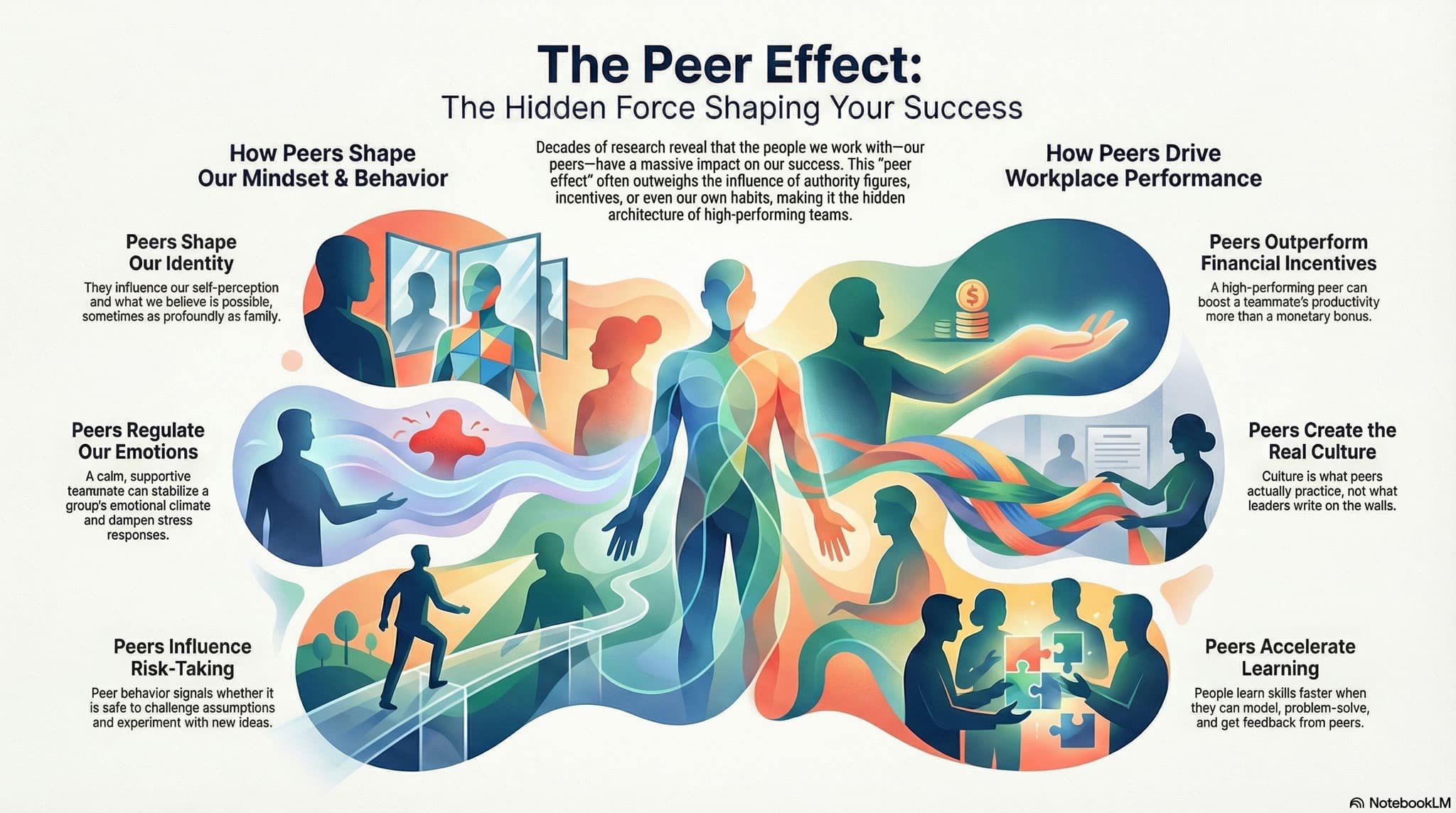
The Research on the Role of Peers
We tend to think of our decisions, beliefs, and behaviors as the logical result of our individual experiences, values, and intentions. Yet decades of research across psychology, neuroscience, organizational behavior, and behavioral economics tell a different story: our peers play a massive role in shaping who we become and how we behave.
Below are ten research-based comparisons that show how much peers influence our performance, well-being, and future paths. In my view, this is why the future of leadership should focus on fostering positive, high-performing peer relationships.
- Peers can shape our behavior as strongly as habits
Robert Cialdini’s research on social norms demonstrates that people follow the expectations of their peer group with the same consistency as they follow personal habits. If your team’s “norm” is preparation, curiosity, and accountability, individuals internalize those behaviors faster than any training program can teach them. - Peers can influence us more than authority figures
Solomon Asch’s conformity experiments revealed that peers can override what people know to be true. Later research showed that dissenting peers significantly reduce blind obedience. Leaders don’t shape culture nearly as much as peer norms do. - Peers can impact our choices as much as incentives
Organizational behavior research shows that the presence of a high-performing peer can boost an individual’s productivity as much, and sometimes more, than financial rewards. Peers shape what people perceive as the “acceptable pace” of work. When a teammate raises their game, it elevates your sense of what’s possible and expected. This was my experience at Mullen (now MullenLowe). Conversely, disengagement spreads quickly. Incentives may motivate in the short term, but peers influence behavior moment by moment. - Peers can regulate our emotions as reliably as coping strategies
Emotional contagion research demonstrates that emotions spread through teams like a social current. Neuroscience shows that supportive peers can dampen physiological stress responses, helping people think more clearly and recover more quickly. A steady, grounded teammate can stabilize the emotional climate of the whole group. Where peers model calm and optimism, resilience grows. Where they amplify anxiety, stress becomes the norm. - Peers can shape our identity as profoundly as family
Across psychology and sociology, peers consistently emerge as central architects of identity. They influence how we define success, what we believe we’re capable of, and who we aspire to become. This is why CEO forums, peer groups, and high-performing teams often spark personal transformation: they redefine possibility and offer a standard that reshapes self-perception. When peers raise the bar, people shed their self-limiting beliefs and rewrite their story of what’s possible. - Peers can determine effort as much as motivation
The expectations and energy of the people around us shape our motivation. Research shows that individuals persist longer, push harder, and prepare better when surrounded by peers who do the same. Shared standards turn intention into action. People rise to meet the group’s level of commitment not because they’re forced to, but because belonging to a high-effort group or team makes excellence feel natural.
- Peers can shape risk-taking as strongly as personality traits
Social neuroscience reveals that peers influence our willingness to take risks as powerfully as stable personality traits. Whether someone speaks up, challenges assumptions, experiments with bold ideas, or avoids risk entirely depends heavily on the behavior modeled by their peers. In psychologically safe environments, peers encourage productive risk-taking. In fear-based environments, they reinforce self-protection. Peers are the signal people follow. - Peers can drive workplace performance and organizational culture
Team-level norms (how peers actually behave with one another) predict learning, collaboration, and performance more strongly than broad organizational conditions. Culture is not what leaders write on the walls; it’s what peers practice in the room. When teams operationalize curiosity, candor, accountability, and preparation, those behaviors spread. When peers normalize blame or avoidance, those habits become the culture instead. Culture is a peer-created phenomenon. - Peers give meaning to other communication sources
In 2019, Edelman asked employees where they find out what’s really happening in their organization; the top answer was their fellow employees. This doesn’t suggest that’s where they initially heard a piece of information; it’s where they interpret its meaning. Employees engage in sense-making exercises with peers. We depend on peers to help us understand reality. - Peers can accelerate learning
Peer learning environments speed up skill development by combining feedback, modeling, social reinforcement, and shared problem-solving. People learn faster when they can compare approaches, test ideas together, and observe how others think. If you want to improve your L&D ROI, internal peer groups will help operationalize learning.
Summary
If there’s one takeaway from decades of research and real-world practice, it’s that peers are the hidden architecture of performance. It’s what runs horizontally through our organizations that gives its vertical pillars strength. Peers shape our habits, our identity, our emotional climate, our willingness to take risks, and to hold high standards, often more powerfully than leaders, incentives, or training programs.
If you want your organization to learn faster, collaborate more effectively, innovate with greater confidence, and achieve results your people didn’t previously see as possible, start by elevating the peer environment. From there, build teams where preparation, curiosity, candor, accountability, and generosity are not the exception; they’re the rule.
Add CEOWORLD magazine as your preferred news source on Google News
Follow CEOWORLD magazine on: Google News, LinkedIn, Twitter, and Facebook.License and Republishing: The views in this article are the author’s own and do not represent CEOWORLD magazine. No part of this material may be copied, shared, or published without the magazine’s prior written permission. For media queries, please contact: info@ceoworld.biz. © CEOWORLD magazine LTD