



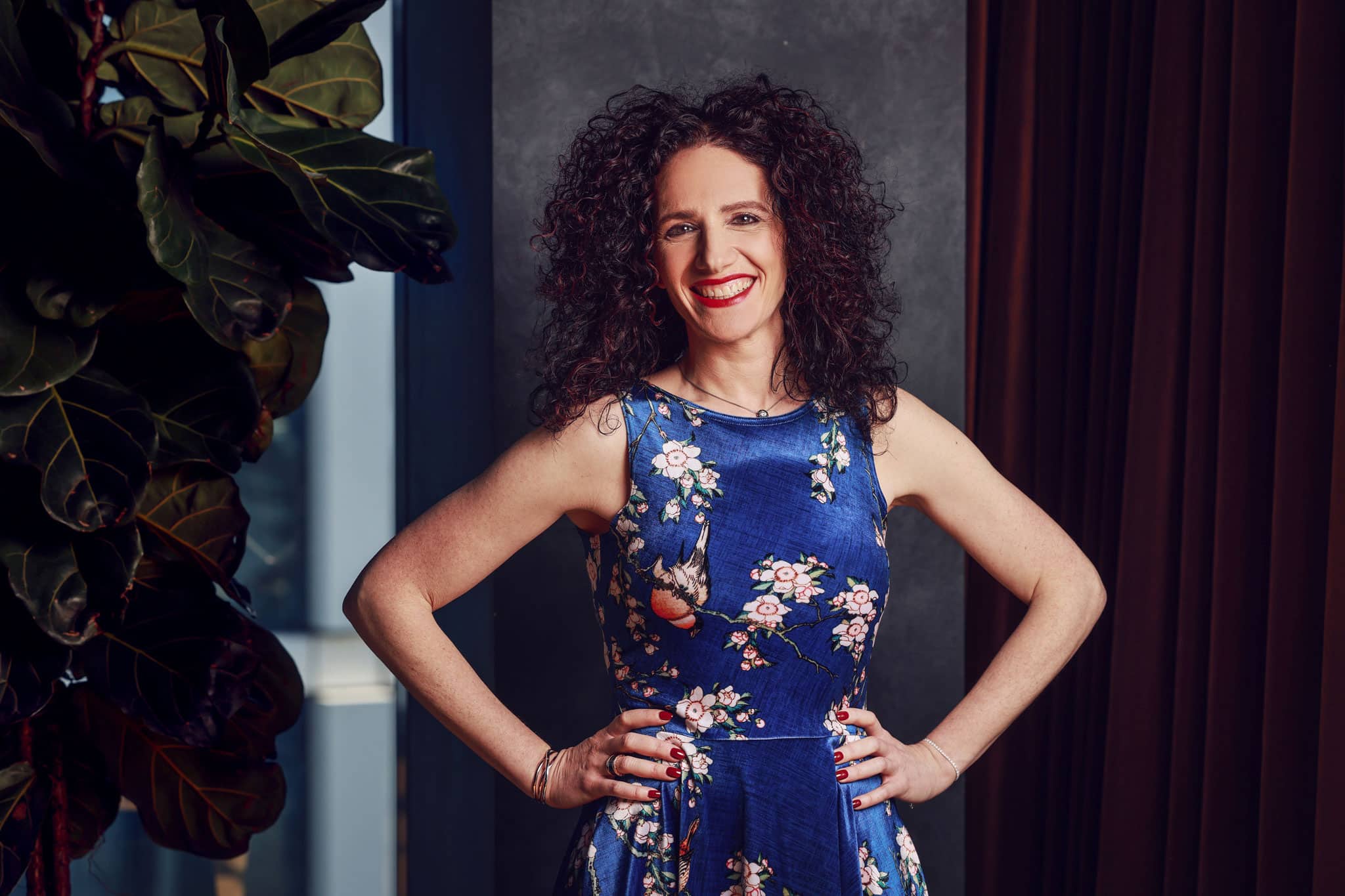
Research shows we judge our own vulnerability through a more negative lens than others do. In what’s known as the ‘beautiful mess effect’, the moments we may perceive as weakness, others might view as courageous. I learnt this the day I got escorted off Facebook’s headquarters in Silicon Valley. I had flown from Melbourne with one mission: find Mark Zuckerberg and make him laugh with my best five minutes of Facebook jokes. To capture attention, I dressed as a giant “Like” button.
After standing outside Facebook’s campus in my costume for nearly an hour, the comms guy agreed to give me a tour. I signed in with security, buzzing with excitement. I felt on top of the world…Then he got a phone call. He turned, looked me straight in the eye, and asked: “Were you outside Mark’s house last night?”
Not exactly the sentence you expect to hear when you’re dressed as an oversized thumb.
Completely thrown off, my body went into full panic mode. My face flushed hot, my throat tightened, and my voice shot up a few octaves. “No… I have no idea where he lives,” I stammered. And even though I told the truth, my body language screamed guilt. Moments later, I was escorted off the property.
What I saw as failure, others saw as courage
I felt humiliated. I had been promoting this quest on social media for weeks and I was certain everyone would now see me as a ridiculous failure. But the opposite happened. People rallied around me. They cheered for me. They thought the story was bold, funny and brave, and supported the aftermath even more than the quest itself.
What I saw as a catastrophic failure, others saw as vulnerability. Daring vulnerability, even. That experience taught me something fundamental: vulnerability doesn’t push people away. It draws them in. And for business owners, that connection is everything. People don’t buy from the most polished brand; they buy from the person or company they trust. And vulnerability and truth build trust.
We often believe people are judging our mistakes, but more often they’re connecting with them – and in the best case, they’re inspired by them. When we take a creative or courageous leap of faith, it shows others what’s possible. As academic, author and researcher Brené Brown explains, vulnerability isn’t weakness; it’s the origin of creativity and innovation.
Your body always tells the truth
The Facebook incident revealed something else that was crucial: incongruence destroys trust. As humans, we are wired to read nonverbal cues. Research shows even babies can read emotional expressions before they understand words. So when your words say one thing but your tone, posture or energy says another, people feel the disconnect instantly. That’s what happened at Facebook; the comms guy wasn’t responding to my words; he was responding to my nonverbals.
And this is where vulnerability and honesty really matter because the moment you start protecting or defending yourself, a disconnect occurs.
Why “I don’t know” builds credibility
I learnt this lesson again early in my speaking career while delivering a keynote presentation. During the Q&A, an audience member asked a question outside my area of expertise. One of my agents was watching me for the first time, and I wanted to appear like “the expert”. So instead of admitting I didn’t know the answer, I pushed ahead and answered anyway. But as I spoke, I could feel myself drifting and rambling – hoping no one noticed I was out of my depth.
They noticed. We always notice when someone is performing a persona instead of telling the truth. After that keynote, I made a decision: I would never pretend to have an answer I don’t have. Now, “I don’t know” is one of the most powerful phrases I use. And every time I say it, my credibility rises. People trust honesty more than perceived perfection.
Vulnerability in the small moments
So how does vulnerability show up every day in business? In the small, simple moments: saying “I need help with this pitch deck” in a meeting, being truthful about what you don’t yet know in a new role, admitting when you make a mistake as a leader, or being honest about your experience, timelines, or capacity in small business.
Vulnerability accelerates trust – and trust is the foundation of relationships, leadership, and genuine connection. We don’t connect with perfection. We connect with truth, and with the human behind the business. In an age of ever-increasing artificial intelligence, vulnerability remains uniquely human. It creates instant connection. Your influence grows when you show up as your full, imperfect, and brilliant self. (Even if, occasionally, you show up dressed as a giant “Like” button.)
—————
Written by Jordana Borensztajn.
Add CEOWORLD magazine as your preferred news source on Google News
Follow CEOWORLD magazine on: Google News, LinkedIn, Twitter, and Facebook.License and Republishing: The views in this article are the author’s own and do not represent CEOWORLD magazine. No part of this material may be copied, shared, or published without the magazine’s prior written permission. For media queries, please contact: info@ceoworld.biz. © CEOWORLD magazine LTD