How One Dubai Investor Uses Renewable Energy to Redefine Gulf Capital

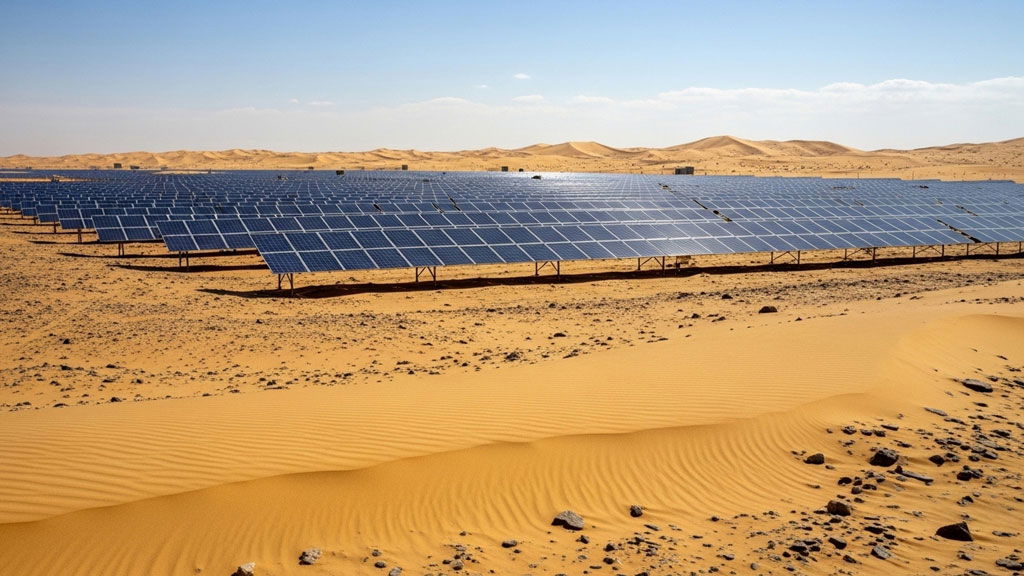
Sheikh Ahmed Dalmook Al Maktoum, Chairman of Inmā Emirates Holdings, is using renewable energy investments to position Gulf capital as a leader in climate finance rather than as a fossil fuel exporter. His portfolio includes a 1,200-megawatt green energy project in Pakistan and a 250-megawatt power plant in Ghana. These projects address energy deficits while establishing credibility in climate finance.
The UAE pledged $4.5 billion to support Africa’s energy transition at COP28, part of a broader $30 billion climate-focused investment initiative. Gulf renewable energy installed capacity increased from less than 500 megawatts in 2017 to nearly 4,000 megawatts in 2022, according to Carnegie Endowment for International Peace analysis. Saudi Arabia aims to reach 130 gigawatts of renewable capacity by 2030, up from less than 5 gigawatts currently.
Strategic Advantages of Renewable Energy Investments
Renewable energy investments serve multiple objectives beyond carbon reduction. They enable Gulf states to diversify economies while maintaining hydrocarbon production.
They position the regional capital as climate-aligned. They create export markets for clean energy expertise developed domestically.
The European Council on Foreign Relations notes that UAE-based Masdar and Saudi Arabia’s ACWA Power can deploy large-scale renewable projects across Africa. ACWA Power investments in Africa reached $7 billion by October 2024. Masdar pledged $2 billion through the Africa50 initiative to deliver 10 gigawatts of clean energy capacity in Africa by 2030.
For emerging market governments, renewable energy projects address immediate power deficits while meeting climate commitments. Pakistan’s 1,200-megawatt capacity advances the country’s clean energy transition while reducing fossil fuel imports.
Ghana’s 250-megawatt plant enhances energy reliability and supports industrialization.
Renewable projects generate different financial returns than conventional infrastructure. Power purchase agreements provide predictable revenue streams over 20 to 30 years. Governments secure baseload capacity without upfront capital expenditure.
Investors gain stable, inflation-protected returns aligned with ESG mandates.
How Climate Finance Differentiates Gulf Investment Models
The UAE established ALTÉRRA, a $30 billion climate-focused fund, to attract global fund managers by capping its own returns on risky investments in developing countries, according to Semafor reporting. This structure addresses a fundamental constraint: private capital covers less than half the financing needed for climate mitigation projects in developing countries, excluding China, according to IMF analysis.
Political and economic risk, low returns relative to perceived challenges, and high costs typically prevent private capital deployment in emerging market renewable energy. ALTÉRRA addresses these barriers through innovative structures:
- Strict caps on returns to attract risk-averse institutional investors
- “First in, capped out” models, where early investors secure positions before returns are limited
- Co-investment arrangements with established global partners
- Seed capital enables fund managers to raise additional financing
Sheikh Ahmed Dalmook Al Maktoum’s renewable energy projects operate within this ecosystem. Pakistan’s green energy project combines Inmā capital with government priorities for energy independence.
Ghana’s power plant addresses West African industrialization while demonstrating the commercial viability of renewable baseload capacity.
The Baker Institute for Public Policy notes that Gulf renewable electricity frees up locally subsidized oil and natural gas resources for export at world prices, while creating investment opportunities beyond domestic markets. This dual economic benefit strengthens the commercial logic for renewable deployment.
Commercial Versus Concessional Climate Finance
Development finance traditionally involves concessional lending below market rates. Commercial climate finance structures projects to generate market returns while delivering environmental impact.
This distinction matters for scale and sustainability.
The UAE’s approach emphasizes commercial structures that attract private capital rather than grant-based assistance. At COP28, the UAE hosted negotiations that generated climate finance commitments while positioning Emirati institutions as execution partners. The $4.5 billion Africa pledge includes commercial investments, technical assistance, and capacity building rather than pure aid transfers.
Sheikh Ahmed’s projects follow this model. Energy infrastructure generates revenue through power sales.
Long-term power purchase agreements provide certainty for investors while ensuring governments secure capacity at negotiated rates. Technology transfer and operational partnerships build local capacity for ongoing maintenance and expansion.
This commercial approach enables scale beyond grant budgets. The International Energy Agency projects that petrochemicals will account for over one-third of oil demand growth to 2030 and nearly half to 2050. Gulf states securing positions in both hydrocarbon value chains and renewable energy create portfolio diversification that Western development institutions cannot replicate.
How Regional Clean Energy Deployment Builds Export Capacity
Domestic renewable deployment creates institutional knowledge and operational capabilities that Gulf investors export to emerging markets. The UAE generates 40 percent of its electricity from nuclear and renewable sources as of March 2024, according to the Washington Institute analysis.
The Barakah nuclear power plant produces 25 percent of the country’s electricity needs.
This domestic experience informs international projects. Masdar developed the Mohammed bin Rashid Al Maktoum solar park in the UAE, building expertise now deployed across Africa and Asia.
ACWA Power operates renewable facilities in the Middle East that serve as reference projects for African governments evaluating technology choices and financing structures.
Technology partnerships also play a role. The Atlantic Council notes that Gulf states support renewable energy projects in overlooked regions, including the Pacific Islands and the Maldives, through institutions like the Abu Dhabi Fund for Development.
These smaller-scale deployments test technologies and financing models later applied at a larger scale.
Sheikh Ahmed Dalmook Al Maktoum’s portfolio includes partnerships that combine:
- Gulf capital providing financing
- International technology providers supplying equipment and expertise
- Local government priorities driving project selection
- Operational partners ensuring long-term maintenance and expansion
The Pakistan project involves solar and wind technology deployed at scale to address national energy planning. Ghana’s power plant integrates with West African grid infrastructure to support regional power trading.
What Climate Finance Positioning Delivers for Gulf Investors
Renewable energy investments address criticism of Gulf states as fossil fuel producers while maintaining hydrocarbon revenues that finance diversification. This strategy enables participation in global climate finance without immediate economic disruption from stranded assets.
The approach also creates access to Western institutional capital requiring ESG compliance. Pension funds and sovereign wealth institutions increasingly mandate climate-aligned portfolios.
Gulf investors deploying renewable energy projects meet these requirements while leveraging relationships in emerging markets where Western institutions face barriers.
Questions Around Gulf Climate Commitments
Critics describe some Gulf climate initiatives as greenwashing. The Atlantic Council notes that UAE-based Blue Carbon has been criticized for carbon colonialism practices, though the UAE Carbon Alliance has been more careful to co-invest with established global partners.
The distinction between genuine transition and reputational management remains contested.
For emerging-market governments, the source of capital matters less than the speed and terms of deployment. Pakistan securing 1,200 megawatts addresses immediate energy deficits regardless of whether investors simultaneously maintain fossil fuel portfolios. Ghana’s obtaining 250 megawatts supports industrialization, whether financing comes from climate-dedicated funds or diversified holding companies.
The durability of Gulf renewable energy commitments will be tested as oil prices fluctuate and political priorities shift. Saudi Arabia and the UAE both maintain net-zero targets while expanding fossil fuel production and refining capacity. Whether renewable investments represent a genuine transition or portfolio hedging remains unclear.
For now, renewable energy projects position Gulf capital as a viable climate finance participant. Sheikh Ahmed Dalmook Al Maktoum‘s Pakistan and Ghana projects demonstrate commercial structures that generate returns while addressing energy deficits. Replication at scale requires maintaining project execution quality, technology transfer effectiveness, and financial transparency.
Add CEOWORLD magazine as your preferred news source on Google News
Follow CEOWORLD magazine on: Google News, LinkedIn, Twitter, and Facebook.License and Republishing: The views in this article are the author’s own and do not represent CEOWORLD magazine. No part of this material may be copied, shared, or published without the magazine’s prior written permission. For media queries, please contact: info@ceoworld.biz. © CEOWORLD magazine LTD